

You tell yourself you are just browsing. Just seeing what is out there. You swipe past a few profiles without thinking too much about it. One person catches your attention. You consider sending a thoughtful message. Then another profile appears. Maybe this one seems more compatible. Maybe this one looks better.
You do not intend to treat people like options. Yet when the next possibility is always just one swipe away, choosing someone can start to feel heavier than continuing to search.
Dating apps have reshaped how people meet potential partners. What once relied on shared spaces, mutual friends, or chance encounters has shifted to a digital landscape where connections begin on a screen.
While speaking to various couples for Unabashed Emotions, I began noticing how often the first chapter of a relationship now starts online.
For many couples, the beginning is no longer a chance meeting at a café, a college introduction, or a friend playing matchmaker.
It is a swipe.
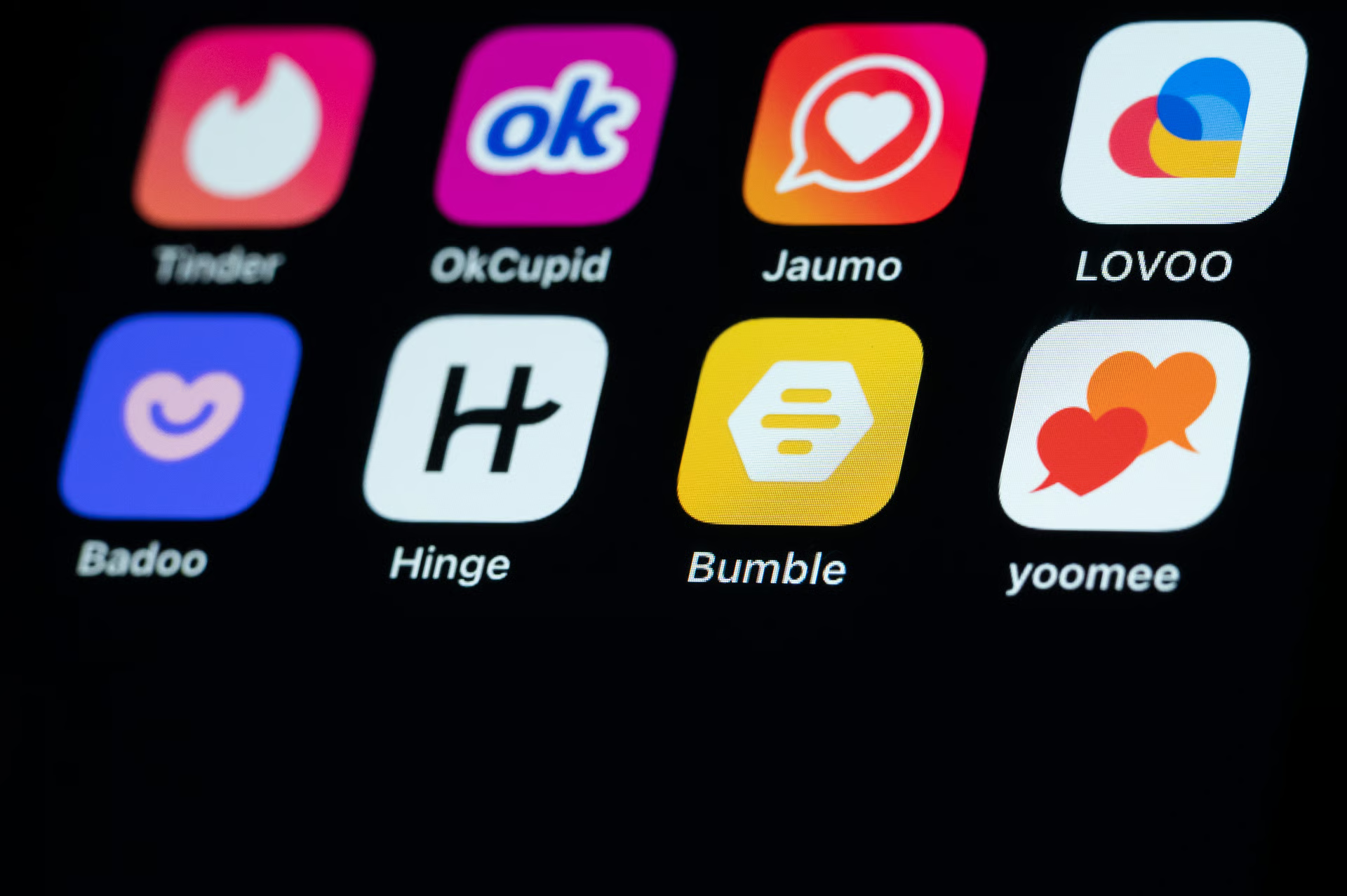
Researchers have observed the same shift. Stanford sociologist Michael Rosenfeld found that meeting online has now become the most common way heterosexual couples meet, surpassing introductions through friends or family.
For many users, this change has expanded opportunities to meet people they might never otherwise encounter. At the same time, it has introduced a new emotional question.
When choice becomes endless, what happens to commitment?
But when every swipe offers another possibility, the abundance of choice can quickly become overwhelming
Gouri Nair, 20, who actively uses dating apps, says the experience often becomes more frustrating than hopeful.
“When I started out, I thought it would help,” she says. “But gradually it became disappointing. It is not really about finding what you are looking for. Many profiles feel questionable, and sometimes the people you match with are simply not compatible.”
At the same time, she recognises that these platforms do serve an important purpose.
“For people who work from home or do not have many spaces to socialise, dating apps give them a platform to meet someone.”
Still, the structure of these apps can create a cycle that is difficult to step away from.
“At the end of the day, it is an app designed to make money,” she says. “It keeps you in this loop where you delete it, download it again, and keep judging people based on the small details they choose to put on their profiles.”
The experience is familiar to many people who have spent time on dating apps. Psychologists describe this pattern as choice overload: the paradox where having too many options can make decisions harder rather than easier. Studies on online dating behaviour have documented this effect.
One study published in Social Psychological and Personality Science found that when people are presented with large numbers of potential partners, they become increasingly critical and more likely to reject profiles. Researchers refer to this pattern as a “rejection mindset”.
This abundance of choice can subtly influence how people approach relationships. Even if someone does not consciously search for better options, the awareness that alternatives exist can change how much effort they invest in a connection.
“I do not hesitate to commit because of other options,” Nair explains. “But there is always a feeling that if this does not work out, you can find someone else. When there are so many options, the amount of effort people put into one connection sometimes reduces.”
Yet the experience is not entirely negative. For some users, interacting with different people helps them understand their own preferences more clearly.
“It has made me clearer about what I do not want,” she says. “When you talk to different people, you start categorising experiences in your mind. It can be positive or negative, but it definitely brings clarity.”
And yet, despite the endless options, some swipes still turn into something real.
Despite these challenges, dating apps are also responsible for countless meaningful relationships. For many couples, the app simply acts as a starting point. What follows depends on the people involved.
Sneha Shaw, who met her partner through a dating app, says their commitment developed quickly.
“When he asked me to be his girlfriend and I agreed, we both stopped using the app,” she says. “That was about five days after we met. It just felt like the right thing to do.”
For her, the platform itself played only a small role in the relationship.
“The app was just a medium,” she explains. “What made commitment easier was the person, and the effort and action that followed.”
Rohini and Yuvraj describe a similar experience. After matching on a dating app, they decided to meet within a week.
“It is that first meeting,” they say. “If you click, you click. After that first meeting we just kept hanging out.”
Talking to multiple matches quickly began to feel exhausting.

“It is a lot of effort to talk to different people about the same things,” they say. “It becomes very draining. After we met, within a week or two we stopped using dating apps.”
For them, commitment has little to do with where a relationship begins.
“There will always be other options, and nobody is perfect,” they say. “What matters is the effort people are willing to put into the relationship.”
There’s a deeper psychology behind why endless choice changes how we approach commitment
According to Krupa Somaiya, counseling psychologist and therapist based in Mumbai and founder of the private therapy practice Krupa Cares, the design of dating apps can subtly influence how people approach relationships.

Somaiya has worked with more than 3,000 individuals and couples through therapy and relationship counselling. She says the abundance of potential partners often creates a constant sense of comparison.
“Dating apps give people access to an almost endless pool of potential partners,” she says. “While that sounds exciting, it can also create a mindset where people start comparing their partner with the idea that someone better might always exist.”
Because dating profiles tend to highlight only a person’s best qualities, these comparisons can become distorted.
“No partner is perfect,” Somaiya explains. “But when we are constantly exposed to profiles showing someone’s best qualities, it becomes easier to overlook the strengths of the person we are already with.”
Over time, this pattern can lead to dissatisfaction even in otherwise healthy relationships.
Somaiya says choice overload also plays a role.
“When people have too many options, making a decision becomes harder,” she says. “Sometimes individuals hesitate to commit because part of them wonders if a better match might appear with the next swipe.”
She also observes that dating culture has become increasingly fast paced.
“Dating apps have made meeting people quicker and easier,” she says. “But relationships can also start to feel rushed. People feel pressure to decide quickly whether someone is worth continuing with, and emotional intimacy does not always get the time it needs to develop.”
Concerns around trust have also become more common.
“In therapy, I often see insecurities around whether a partner might still be active on dating apps,” she says. “That uncertainty can make it harder for people to feel emotionally safe and fully invested in a relationship.”
Which raises a larger question: How do people choose commitment in an age of endless options?
Despite these challenges, Somaiya believes meaningful relationships remain very possible. The difference is that commitment now requires more intention.
“If someone is looking for a serious relationship, it can help to slow the process down,” she says. “Instead of constantly searching for the next match, focusing on deeper conversations with fewer people often leads to stronger connections.”
Sometimes the most important step is reflection.
“I often ask my clients a simple question,” she says. “What matters more right now. Building a meaningful relationship, or continuing the endless cycle of swiping?”
Dating apps did not invent uncertainty in love. But they did bring it closer. Closer to our pockets. Closer to our everyday decisions.
In a world where romantic possibilities appear limitless, commitment may no longer happen automatically. Instead, it has become something people choose consciously.
Because in an age of endless options, love is no longer just about finding someone. It is about deciding that one person is worth choosing and continuing to choose them, even when other possibilities exist.